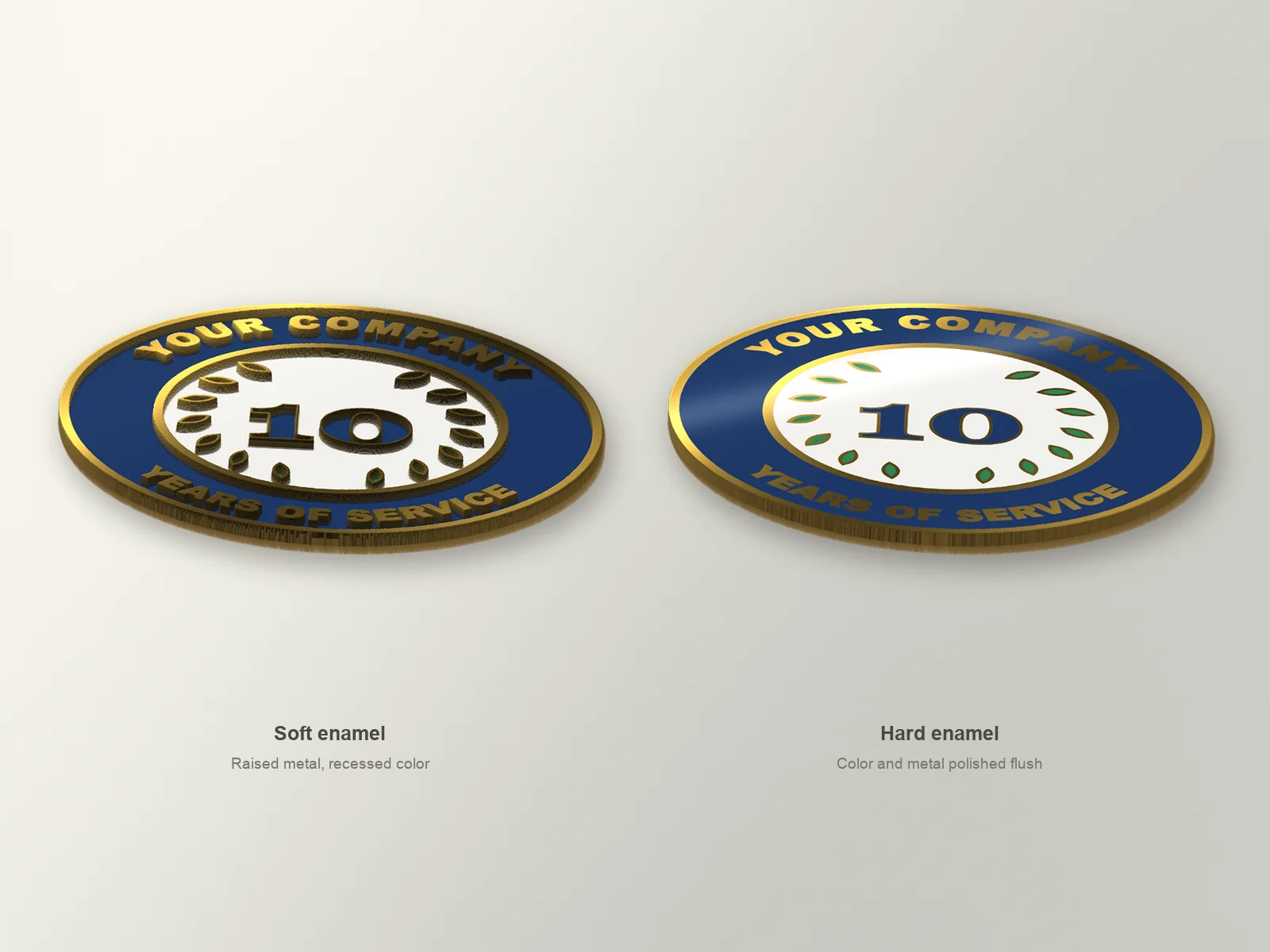
The difference in one sentence
On a soft enamel pin, the color sits below the raised metal lines, so the surface is textured; on a hard enamel pin, the color is filled level with the lines and polished flat, so the surface is smooth.
Side-by-side comparison
| Item | Soft enamel | Hard enamel |
|---|---|---|
| Surface | Textured, you can feel the lines | Smooth and flat |
| Look | Bright, saturated, playful | Polished, jewelry-like |
| Durability | Good; raised lines protect color | Excellent; resists scratches |
| Detail | Very fine lines hold well | Lines need to be a bit thicker |
| Effects | Glitter, glow, screen print, epoxy all work well | Effects are limited or dulled by polishing |
| Price | Lower | About 10% higher |
| Typical uses | Trading pins, events, giveaways, playful designs | Awards, corporate pins, retail pins, nursing pins |
How each is made
Both start as a struck metal blank with recessed areas. For soft enamel, the blank is plated first, then each color is filled once and baked. The enamel shrinks a little as it cures, leaving it below the lines. For hard enamel, the color is filled in several layers until it rises above the lines, baked at a higher temperature, then ground and polished flat before final plating. Our guide how to make enamel pins shows each step.
Which looks better?
Neither; they look different. Soft enamel colors often appear brighter because the surface is not polished and the colors are a little more saturated. The texture also gives soft enamel pins a handmade, playful character. Hard enamel looks more refined: light reflects evenly across the surface, and edges between metal and color are razor sharp.
Durability
Hard enamel wins for pins worn daily for years, because there is no exposed edge of enamel to chip and the polished surface resists scratches. That said, soft enamel pins hold up well in normal use; the raised lines take most of the wear. A thin epoxy dome adds protection to soft enamel if needed.
Cost
At the same size and quantity, hard enamel costs about 10% more:
| 1-inch pins, delivered | 100 pcs | 300 pcs | 500 pcs |
|---|---|---|---|
| Soft enamel | $3.20 | $2.10 | $1.75 |
| Hard enamel | $3.52 | $2.31 | $1.93 |
All sizes are on our pricing page.
Which designs suit each
Choose soft enamel if your design uses glitter, glow or printed details; it has very fine lines; it is for trading, events or giveaways; or you want the lowest price.
Choose hard enamel if the pin is an award or a gift; it will be worn daily on a uniform or suit; it is for retail and you want it to feel premium; or your design is bold with clean shapes.
What about "imitation hard enamel" and cloisonné?
Most hard enamel pins today use synthetic enamel, sometimes called imitation cloisonné. True cloisonné uses powdered glass fired at high temperature: very durable and beautiful, but several times the cost with a narrower color range. See hard enamel vs cloisonné.
Still undecided?
Send your design on the quote form and ask for both. We will show the proof and price for each, and recommend the one that suits your design. You can also feel both in our sample pack, or read more on the soft enamel and hard enamel pages.
How they look in photos and in hand
In product photos, soft enamel pins catch light on the raised metal lines, so the outlines sparkle while the colors sit slightly in shadow. Hard enamel pins reflect light evenly across the whole face, so they photograph like a smooth, glossy tile. In hand, the difference is immediate: soft enamel has a tactile, slightly handmade feel, while hard enamel feels finished and heavier, partly because it is often made from brass.
If you sell pins online, this matters. Soft enamel photographs best at an angle that shows texture; hard enamel photographs best straight on with soft light.
Six common projects and what we recommend
| Project | Recommendation | Why |
|---|---|---|
| Youth trading pins | Soft enamel | Bright colors and glitter, lower cost at 2+ inches |
| Years of service awards | Hard enamel | Worn for years, should feel like jewelry |
| Conference giveaway | Soft enamel | Lowest cost per pin, colors pop |
| Nursing pins | Hard enamel | Worn for a career, traditional polished look |
| Artist retail pins | Either | Hard enamel for premium, soft enamel for glitter and effects |
| Awareness ribbon pins | Soft enamel | Large quantities, glitter ribbons are popular |
Myths worth correcting
"Hard enamel always looks more expensive." Not always. A well-designed soft enamel pin with antique silver lines can look more striking than a plain hard enamel pin.
"Soft enamel chips easily." The enamel sits below the metal lines, which take most of the wear. Chips are rare in normal use.
"You can't have glitter on hard enamel." You can, but polishing flattens the glitter and reduces the sparkle, which is why glitter pins are usually soft enamel.
"Soft enamel is lower quality." It is a different finish, not a lower grade. Quality depends on the mold, the plating and the care taken filling the enamel.
Cost over the life of a pin
For a pin someone wears once at an event, the 10% saving of soft enamel is the smart choice. For a pin worn every day for five years, such as a staff pin or a nursing pin, hard enamel's durability makes the extra cost per year negligible. Think about how long and how often the pin will be worn, not only the price per piece.
How to compare both on one proof
On the quote form, write "please quote soft and hard enamel". The proof will show the same design both ways with a price for each, so your committee or client can choose with the numbers side by side.
Written by the Enamelore team, who proof every order. Questions about this guide? Email hello@enamelore.com.