What a pinning ceremony is
A pinning ceremony is a separate event from the university or college commencement, held just for the nursing program's graduates. Each graduate is called forward and receives the school's nursing pin, a symbol of their education and their entry into nursing. It is usually smaller and more personal than commencement, and families are often invited to take part.
When do nursing students get pinned?
At the end of the nursing program, usually in the final week of the last semester, a few days before or after commencement. In most associate degree (ADN) programs that is the end of the second year; in a traditional BSN, the end of the fourth year. Accelerated BSN, LPN and RN-to-BSN cohorts are pinned when their own program finishes. Schools with fall graduates often hold a December pinning as well as the one in May, so pins for a winter class need to be ordered in the fall.
What year of nursing is capping and pinning?
Traditionally they came at different points. In the hospital diploma schools where both customs began, students were usually capped after their first months of study, often at the end of the first year, when they started caring for patients, and pinned when they completed the program. Some schools later combined the two into a single "capping and pinning" ceremony at graduation. Few schools present caps today, so for most students the pinning at the end of the final year is the only ceremony.
History of the nursing pin
The tradition is most often traced to Florence Nightingale, who founded the Nightingale Training School for nurses at St Thomas' Hospital in London in 1860; accounts describe her honoring outstanding graduates with a badge or medal. Some historians trace nursing badges further back to the Knights Hospitaller, whose cross appears in many nursing pins. By the early 20th century, nursing schools in the United States commonly gave each graduate a pin bearing the school's insignia, so that a nurse's pin showed where they trained. Many schools once held "capping" ceremonies as well, presenting nursing caps; as caps fell out of use in the late 20th century, pinning became the main ceremony.
What the pin represents
Each school's pin is unique. Common symbols include the lamp of knowledge (for Nightingale, "the Lady with the Lamp"), a cross, the school's crest or seal, laurel leaves, and the program or degree. The pin represents the graduate's education and commitment to care, and many nurses wear their school pin on their uniform throughout their careers.
A typical order of events
- Processional of graduates, often in white
- Welcome from the program director or dean
- Speakers: a faculty member, a guest nurse leader or a student speaker
- Presentation of pins: each graduate is called by name and pinned
- Lamp lighting or candle lighting
- Recitation of a nursing pledge, such as the Nightingale Pledge (written in 1893 by a committee led by Lystra Gretter in Detroit) or a modern version
- Awards for clinical excellence, leadership and service
- Closing remarks and recessional
- Reception for graduates and families
How long does a pinning ceremony last?
Usually 60 to 90 minutes, depending on class size. Every graduate is called forward and pinned individually, so a large class can take close to two hours; plan extra time for photos and the reception afterwards.
Who pins you at a nursing pinning ceremony?
Traditions vary. In many programs, each graduate chooses someone meaningful to pin them: a parent, spouse, child, mentor or a nurse who inspired them. In others, faculty members pin each graduate. Some schools let graduates choose between the two. The pin is placed on the left side, over the heart.
What to wear
Many programs ask graduates to wear white uniforms or white scrubs, recalling nursing's traditional dress; others ask for professional attire or the graduation gown. Check your program's guidance. Pins are usually presented in a small box and attached during the ceremony with a clutch.
Planning timeline for nursing programs
| When | Task |
|---|---|
| 4 to 6 months before | Set date and venue; confirm budget; decide who pins graduates |
| 3 months before | Finalize the class list; confirm pin design and order details |
| 8 to 10 weeks before | Order nursing pins (approve the proof by this date) |
| 6 weeks before | Invite speakers; plan the program and pledge |
| 4 weeks before | Send invitations; print programs |
| 2 weeks before | Rehearsal plan; seating; lamps or candles |
| 1 week before | Check pins against the class list; prepare name cards |
Ordering nursing pins
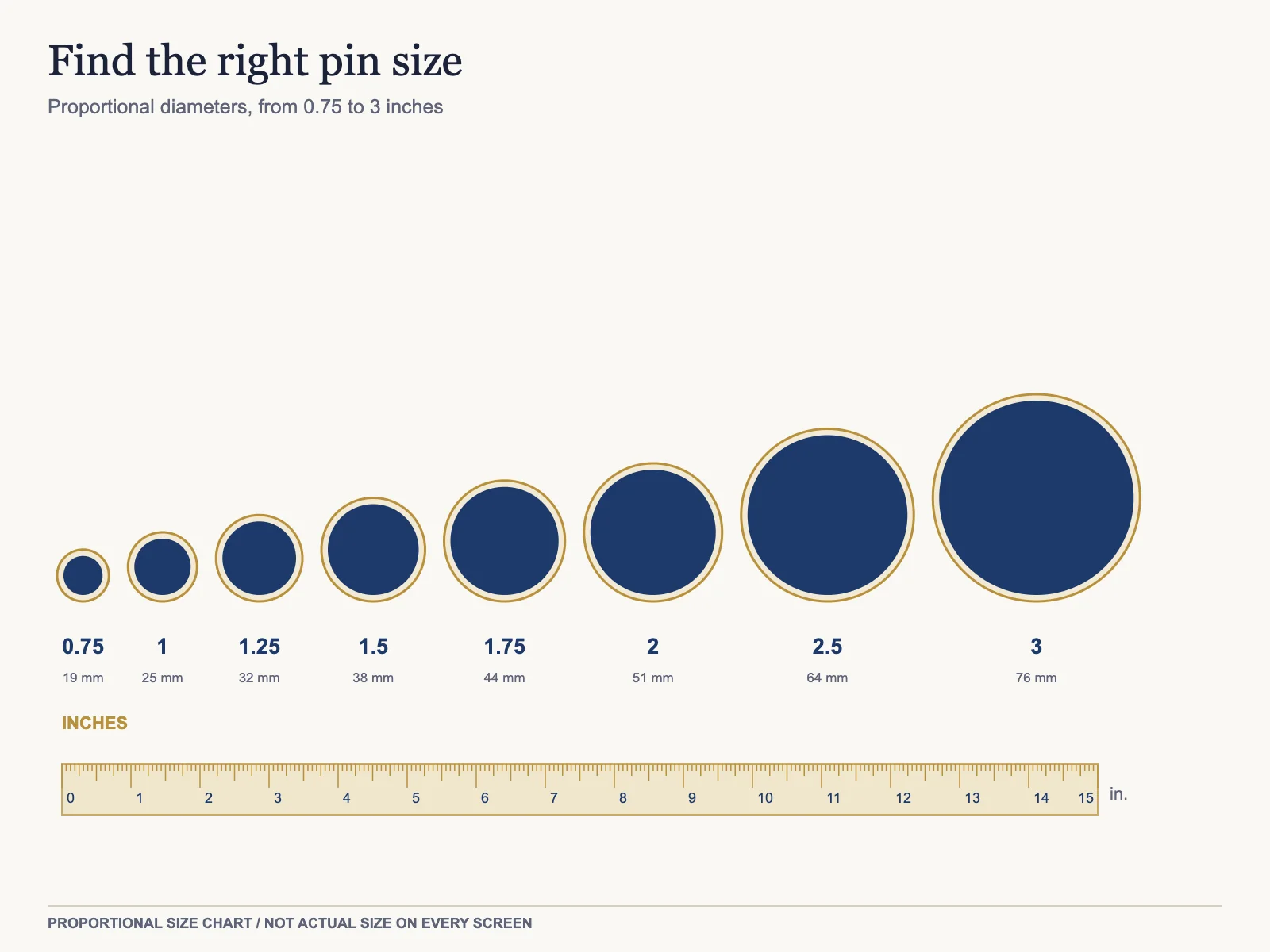
Most programs reorder the same pin design every year, with the graduation year or program engraved. If your school is designing a pin for the first time, or replacing an old design, we can recreate an existing pin from a photo or design a new one from your crest. Pins are usually 0.75 to 1 inch in hard enamel with a gold-tone finish, presented in a velvet box. See nursing pins for pinning ceremonies for designs and prices.
| Size | 50 pcs | 100 pcs | 200 pcs | 300 pcs | 500 pcs | 1,000 pcs | 2,000 pcs |
|---|---|---|---|---|---|---|---|
| 0.75 in. | $4.84 | $3.19 | $2.37 | $2.04 | $1.71 | $1.32 | $1.21 |
| 1 in. | $5.39 | $3.52 | $2.64 | $2.31 | $1.93 | $1.49 | $1.38 |
Price per pin in USD, delivered with shipping and import duties included. Up to 8 colors, a shiny or antique gold, silver or copper finish, rubber clutch (two per pin on pins 1.5 in. and larger) and individual poly bag included.
Pins for students: buying your own
At some schools, graduates buy their pins individually through the school or the student nursing association. If your class is organizing the order, collect payment early, confirm names for engraving, and order a few extra pins for late graduates and replacements.
After the ceremony
Many hospitals celebrate new nurses again during Nurses Week in May. For gift ideas for new graduates and working nurses, see Nurses Week gift ideas.

Nursing Pinning Collection: product animation of designs from our collection.
Written by the Enamelore team, who proof every order. Questions about this guide? Email hello@enamelore.com.