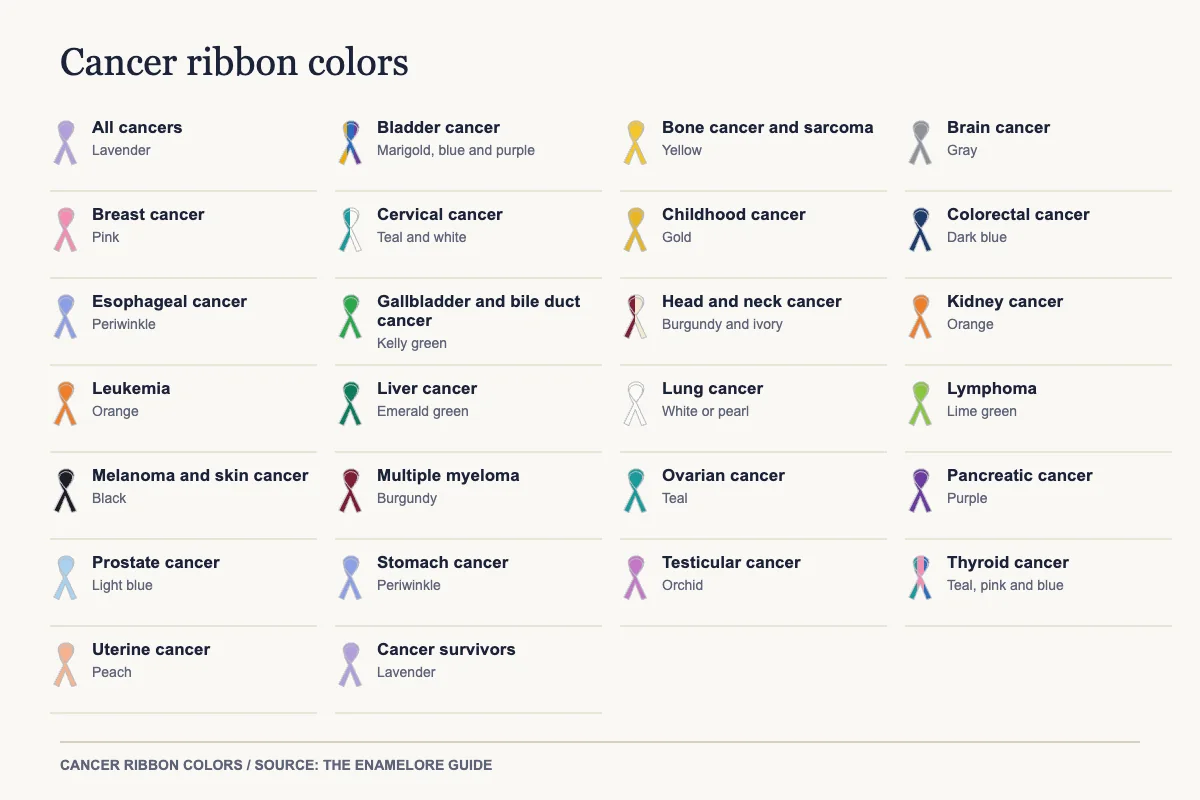
Cancer ribbon colors and awareness months
| Cancer | Ribbon color | Awareness month (US) |
|---|---|---|
| All cancers | Lavender | February 4 is World Cancer Day |
| Bladder cancer | Marigold, blue and purple | May |
| Bone cancer and sarcoma | Yellow | July |
| Brain cancer | Gray | May |
| Breast cancer | Pink | October |
| Cervical cancer | Teal and white | January |
| Childhood cancer | Gold | September |
| Colorectal cancer | Dark blue | March |
| Esophageal cancer | Periwinkle | April |
| Gallbladder and bile duct cancer | Kelly green | February |
| Head and neck cancer | Burgundy and ivory | April |
| Kidney cancer | Orange | March |
| Leukemia | Orange | September |
| Liver cancer | Emerald green | October |
| Lung cancer | White or pearl | November |
| Lymphoma | Lime green | September |
| Melanoma and skin cancer | Black | May |
| Multiple myeloma | Burgundy | March |
| Ovarian cancer | Teal | September |
| Pancreatic cancer | Purple | November |
| Prostate cancer | Light blue | September |
| Stomach cancer | Periwinkle | November |
| Testicular cancer | Orchid | April |
| Thyroid cancer | Teal, pink and blue | September |
| Uterine cancer | Peach | September |
| Cancer survivors | Lavender | June (National Cancer Survivors Day is the first Sunday) |
Ribbon colors are conventions adopted by patient groups and charities, not rules set by a single authority. Most are widely agreed; a few cancers use more than one color in different organizations. If you are making materials for a specific charity, use the color it uses.
Shared colors
Several cancers share a color, which can cause confusion:
- Orange: leukemia and kidney cancer
- Periwinkle: stomach and esophageal cancer
- Teal: ovarian cancer (and, outside cancer, sexual assault awareness)
- Purple: pancreatic cancer (and domestic violence, Alzheimer's and others)
- Lavender: all cancers, and cancer survivors
When a color is shared, add words. A pin that says "Pancreatic Cancer Awareness" or the name of your organization removes any doubt. See awareness ribbon colors and meanings for non-cancer causes.
Where ribbon colors come from
The modern awareness ribbon grew from the yellow ribbons displayed for hostages and service members in the late 1970s and the red ribbon created by artists in 1991 for HIV/AIDS awareness. The pink ribbon for breast cancer followed in the early 1990s. Since then, charities for many causes have adopted their own colors, often choosing one that was not yet in wide use.
When each cancer is observed
The months in the table are the most widely observed in the United States; some organizations observe a week or a day instead, and other countries may use different months. Our awareness months calendar lists cancer months alongside other causes, so you can plan a year of campaigns.
Using ribbon colors well
- Match the exact shade. Pink and lavender, or teal and light blue, look similar on a small pin. Pantone numbers help.
- Add the cause in words. Especially for shared colors.
- Be respectful. Cancer ribbons are worn by patients, survivors and families. Keep designs dignified.
- Plan for the month. Order pins at least six weeks before the awareness month begins.
Awareness ribbon pins for your campaign
Our ready-made awareness ribbon pins include every major cancer in its traditional color, with space for your organization's name. Popular designs include the breast cancer awareness ribbon pin and the childhood cancer awareness ribbon pin. For fundraising ideas, see charity and fundraising pins.
How to wear a cancer awareness ribbon
Wear the ribbon pin on the left side, over the heart, during the cancer's awareness month, at walks and runs, or every day in honor of someone. Many people wear the ribbon for a family member's diagnosis date or anniversary. There are no strict rules: wearing the ribbon is a gesture of support, and it opens conversations about screening and research.
Supporting someone with cancer
A ribbon is a symbol; practical support matters more. Ask what would help, offer specific help (meals, rides, childcare), and keep in touch after the first weeks, when support often fades. If you are organizing a team for a walk or fundraiser, matching ribbon pins with the person's name or team name on the back can make the day feel personal.
Ordering ribbon pins for a cancer campaign
Hospitals, cancer centers, schools and companies order ribbon pins for awareness months, walks and survivor events. Start from a ready-made ribbon in the correct color, add your organization's name or the cause in words, and approve the proof at least six weeks before the month starts. At 500 pieces, a 1-inch ribbon pin is $1.75, delivered. See awareness ribbon pins and charity and fundraising pins.
Written by the Enamelore team, who proof every order. Questions about this guide? Email hello@enamelore.com.